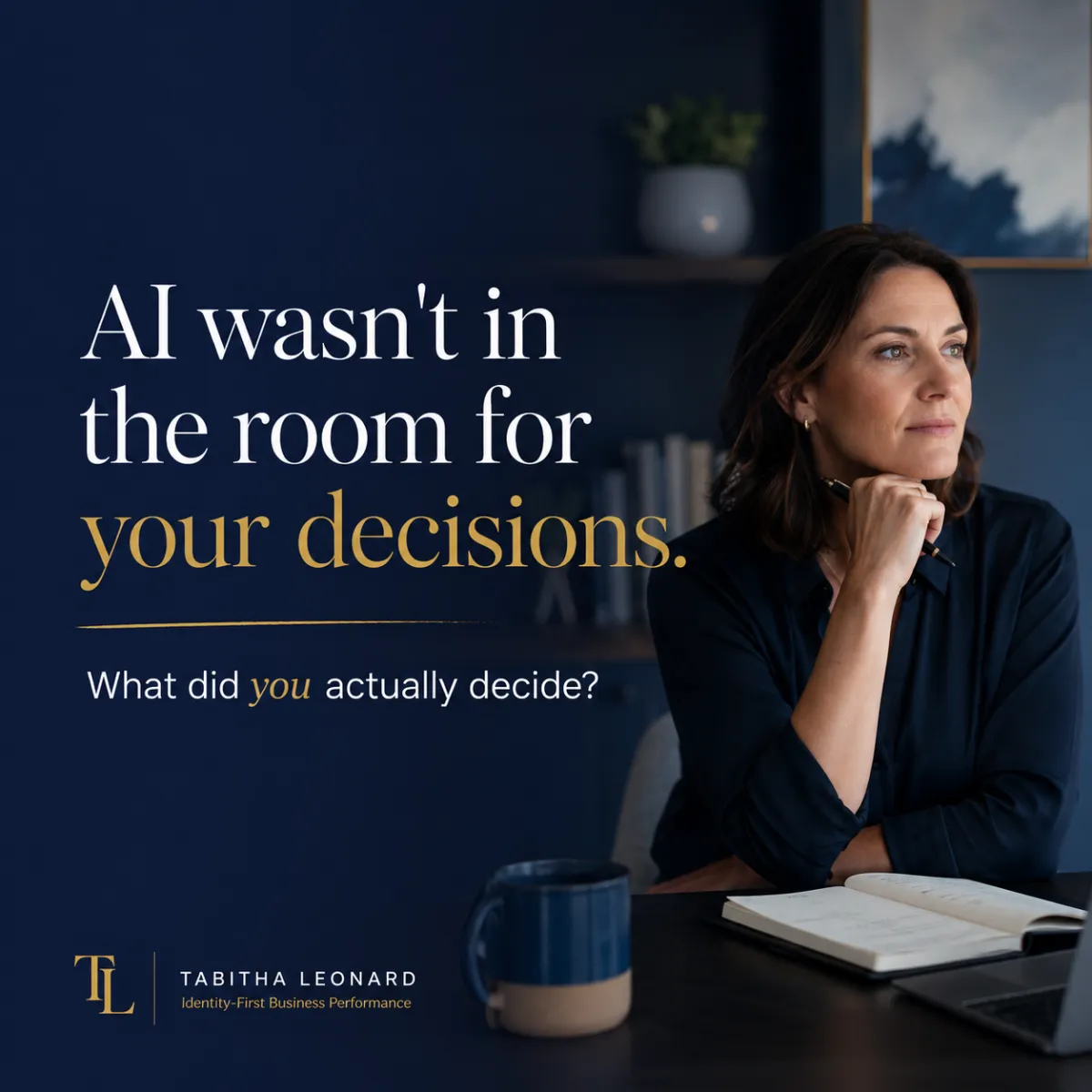
Who Are You When AI Can Do What You Do?
Who Are You When AI Can Do What You Do?
You read the email twice.
"We've decided to go in a different direction."
No reason given. No real explanation. Just that line, sitting in your inbox, doing nothing and everything at once. You close the laptop. You open it again ten minutes later. And underneath the disappointment, a quieter question starts circling — one you don't say out loud, even to yourself.
If a tool can do what I built this business doing, what does that make me?
That question doesn't go away by Friday.
The Friction
This isn't really about the client. You know that, even as you reread the email a third time.
It's about what the loss seems to confirm. You built your offer around being the one who notices what others miss, who holds the relationship, who makes the calls that can't be templated. So when a client leaves and AI is even a rumour in the room, it doesn't just cost you revenue. It costs you the story you were telling about why you matter here.
That story made sense. You built it for good reason — clients need to trust that the person doing the work is paying full attention, not phoning it in. So you made yourself the proof. You made your presence the guarantee. It worked, for a long time. Which is exactly why losing a client now feels like more than losing a client.
The Misconception
Here's what you've likely been believing without naming it: that your worth as an operator is measured by how much of the work only you can do.
That's not authorship. That's a different thing wearing authorship's clothes.
The Identity Pattern Underneath
Think of it like this. You've been standing guard at a door, convinced that if you ever step away from it, the whole building falls. So you stay there — checking, doing, proving — because the door has quietly become the only place you feel certain you still matter.
But you were never the door. You're the one who decided what's allowed through it.
That's the gap. Somewhere in building this business, you let "I do the work" and "I am the author of this work" become the same sentence. They're not. One is a task list. The other is a stance — a way of staying decisively, visibly in charge of what you build, regardless of which tools pass through your hands to build it.
AI didn't create this gap. It just stood in the doorway long enough for you to notice it was there.
The Authorship Check
This is where Human Ownership becomes practical instead of philosophical. Before you credit — or blame — AI for an outcome, run it through three questions. Each one cuts a little deeper than the last.
One: What did I actually decide here? Not what got produced. What did you choose — the angle, the boundary, the no, the yes?
Two: Would I still trust this decision if I'd made it without AI in the room? If the answer is yes, the tool was leverage. If you're not sure, that's worth sitting with.
Three: If this work disappeared tomorrow, would I still know who I am as an operator? This is the one that matters. Not because it's comfortable — because it's the question client loss was forcing you toward anyway.
Run any decision, any week, any client relationship through these three, in order. By the third question, you'll know whether you've been operating from authorship or from proof-seeking.
A Real Shift in Action
One client — a strategy consultant in her tenth year of business — came to a session convinced she needed to "out-AI" a competitor who'd started offering instant reports. She wanted a bigger tool, a faster turnaround, something to win the comparison.
She ran the loss through the Authorship Check instead. By the second question, she stopped talking about tools entirely. What her clients had actually been paying for, she realised, was never the report. It was the fifteen minutes before she wrote it — the part where she asked the question nobody else had asked, the part no competitor's tool had access to because it had never had access to her.
She didn't change her offer that day. She changed what she believed was hers.
The Closing Truth
You weren't replaced. You were exposed.
Exposed to a question you'd been avoiding by staying busy.
AI didn't take your client. It revealed what you'd been quietly asking your work to confirm.
That confirmation was never available out there. It was only ever going to come from you deciding it.
Who remains the author? You do.
This Week's Coached AI Prompt: The Authorship Mirror
Use this when a client decision — a loss, a win, anything that stings or surprises you — leaves you unsure what was actually yours.
I want you to act as a mirror, not a judge.
Here's what happened: [describe the client situation — what you did, what the client said or decided, what role AI played, if any]
Don't tell me what to think about it. Instead, reflect back:
1. What specific decisions in this situation were mine alone?
2. Where did my judgement, relationship, or instinct show up — even quietly, even in something small?
3. What's one thing in this story that no AI could have produced, because it required me being the operator I am?
Keep your reflection short. Don't soften it and don't inflate it. I'll decide what it means.
Paste in your situation, read what comes back, and notice what you already knew before you typed it. That's the part that was always yours. The AI didn't hand you the answer — it just got out of the way long enough for you to hear yourself.
One Move
Find the last client decision — win or loss — that you've been quietly crediting to "well, the AI helped." Today, not this weekend, run it through the three Authorship Check questions above. Write down one sentence: what was actually yours. Close the loop before you open another tab.
Next Step
If this is the conversation you've been having with yourself at 11pm and need to have properly, with someone in the room —
Book a call with Tab → https://www.tabithaleonard.com/schedule-a-call
Because the question underneath the client loss isn't going to answer itself. It's waiting for you to decide.


