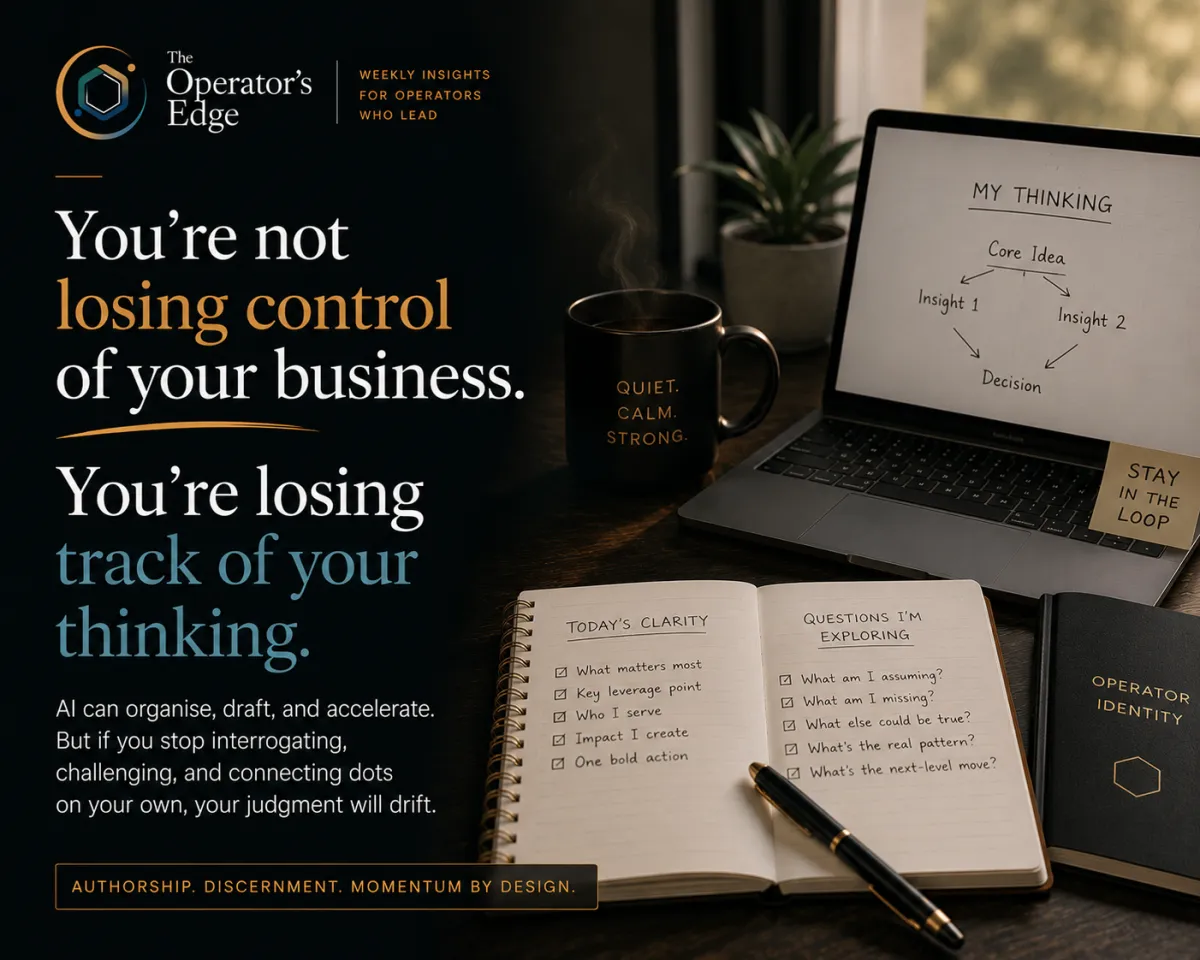
You're not losing control of your business. You're losing track of your thinking.
You're not losing control of your business. You're losing track of your thinking.
Read time: 4 minutes
In this issue:
Why the most capable operators are quietly handing over their judgement — and how to notice if you're one of them
This week's AI prompt: a discernment audit you can run in under ten minutes
One move before Friday: map your decisions, find the gaps
When Did You Last Make a Decision That Was Fully Yours?
Not a decision you approved after the output was already drafted. Not a direction you confirmed because it felt faster. A decision that came from your thinking, your instincts, your read of the situation.
Take a moment with that.
For a lot of operators right now, the answer is slippery. Not because they're careless. Because they're efficient. And somewhere in the pursuit of moving faster, the line between "AI helped me think this through" and "AI did the thinking" got quietly crossed.
That's the gap we're working with today.
The Misconception That Makes It Invisible
Here's what makes this particular drift so hard to catch: it doesn't feel like abdication. It feels like leverage.
You've been building systems, using tools, creating efficiencies. That's real. That's been working. The effort behind your AI integration has been genuine, and the output has been better, faster, more consistent.
So when a recommendation comes back from your AI and it sounds right — you move on it. Of course you do. That's the point.
But "sounds right" is not the same as "I've decided." And that distinction is where your authority lives.
A Real Shift in Action
A client came to a session recently frustrated. Not with results — results were fine. With herself. She described a moment in the previous week where she'd taken a significant decision to a client based on AI-generated analysis, and only when pushed back on did she realise she couldn't explain the reasoning. The output had been good. Her ownership of it had not.
That was the moment she named it: she had been approving, not deciding.
One session, one reframe, and the habit she built from there wasn't to use AI less. It was to stay in the authoring seat — every time.
What's Actually Running Underneath
This isn't a tech problem. It's an identity pattern.
When you're operating under cognitive load — which, as an SME owner, is most of the time — your nervous system looks for shortcuts. That's not weakness. That's biology. But when your shortcut is "let the AI decide and I'll review," you're not operating as an author. You're operating as an approver.
Think of it like this: you're sitting in the co-pilot seat, but the aircraft is flying. You're watching the instruments, you're nominally in control, and everything feels fine. Until the conditions change and you realise you haven't had your hands on the controls in longer than you thought.
The drift is quiet. That's what makes it costly.
Deloitte's 2026 Global Human Capital Trends report found that 60% of executives are already using AI in their decision-making. Only 5% have developed the capability to manage it well. That gap — 60% using, 5% governing — is exactly where most capable operators are sitting right now. Not failing. Just… unmanaged.
The fifth pillar in my framework - Human Intelligence in the Artificial Intelligence Age - is Human Ownership. It's the standard that says: I decided, not my clone told me. It's the difference between a tool that amplifies your thinking and a tool that replaces it.
The Discernment Audit: Three Questions Before You Move
Next time an AI output is sitting in front of you, run this before you act on it:
1. Can I reconstruct the reasoning? Not repeat it. Not paraphrase it. Reconstruct it in your own words, from your own understanding. If you can't, you're not ready to act on it yet.
2. Does this align with what I actually know about this situation? AI operates from your inputs. If your inputs were incomplete, the output will be confident and wrong. Your context is irreplaceable.
3. Am I the author of this decision, or the approver of this output? One of those positions carries authority. The other carries compliance. You know which one your business needs from you.
These aren't questions that slow you down. They're the questions that keep you in the decisions that matter.
This Week's AI Prompt — Discernment Check-In
What this prompt is for: Surfacing the decisions where your AI is doing more thinking than you are.
"I'm going to list five decisions I've made or acted on in the past week that involved AI input. For each one, I want you to ask me: Can I explain the reasoning behind this decision in my own words? Does my own knowledge of this situation support this direction? Was I the author of this decision or the approver of the output? Help me identify which of these decisions were fully mine and which ones I need to revisit."
Run it as a genuine audit, not a validation exercise. Where the answer to any of the three questions is "no" or "I'm not sure" — that's the gap.
The AI reflects what you give it. Your discernment is what you bring.
One Move Before Friday
List every recurring decision in your business that now has an AI step in it. Email responses, content direction, client recommendations, financial calls — everything.
Then, next to each one, write a Y or an N: is there a human checkpoint before this goes out or gets acted on?
Any decision marked N that is relational, financial, or high-stakes needs a checkpoint added. Not because the AI is wrong. Because you are the author. That's non-negotiable.
Fifteen minutes. A piece of paper or a doc. Do it today — not this weekend.
Ready to Do This With Support?
Book a free strategy call [BOOKING LINK]
If this issue named something you've been half-aware of but haven't known how to address, that's exactly what a strategy call is for. We'll look at where you are in your AI integration, identify where the human checkpoints are missing, and map what it looks like for you to stay fully in the authoring seat.
One conversation. Clear direction. No obligation.
Who remains the author? You do. By design, not by default. — Tab


