Who Remains the Author?
Who Remains the Author?
You are using AI every day now.
You're drafting faster. Deciding faster. Moving faster.
And somewhere in that speed, something subtle is happening — something you haven't quite named yet.
The Thing Nobody Is Measuring
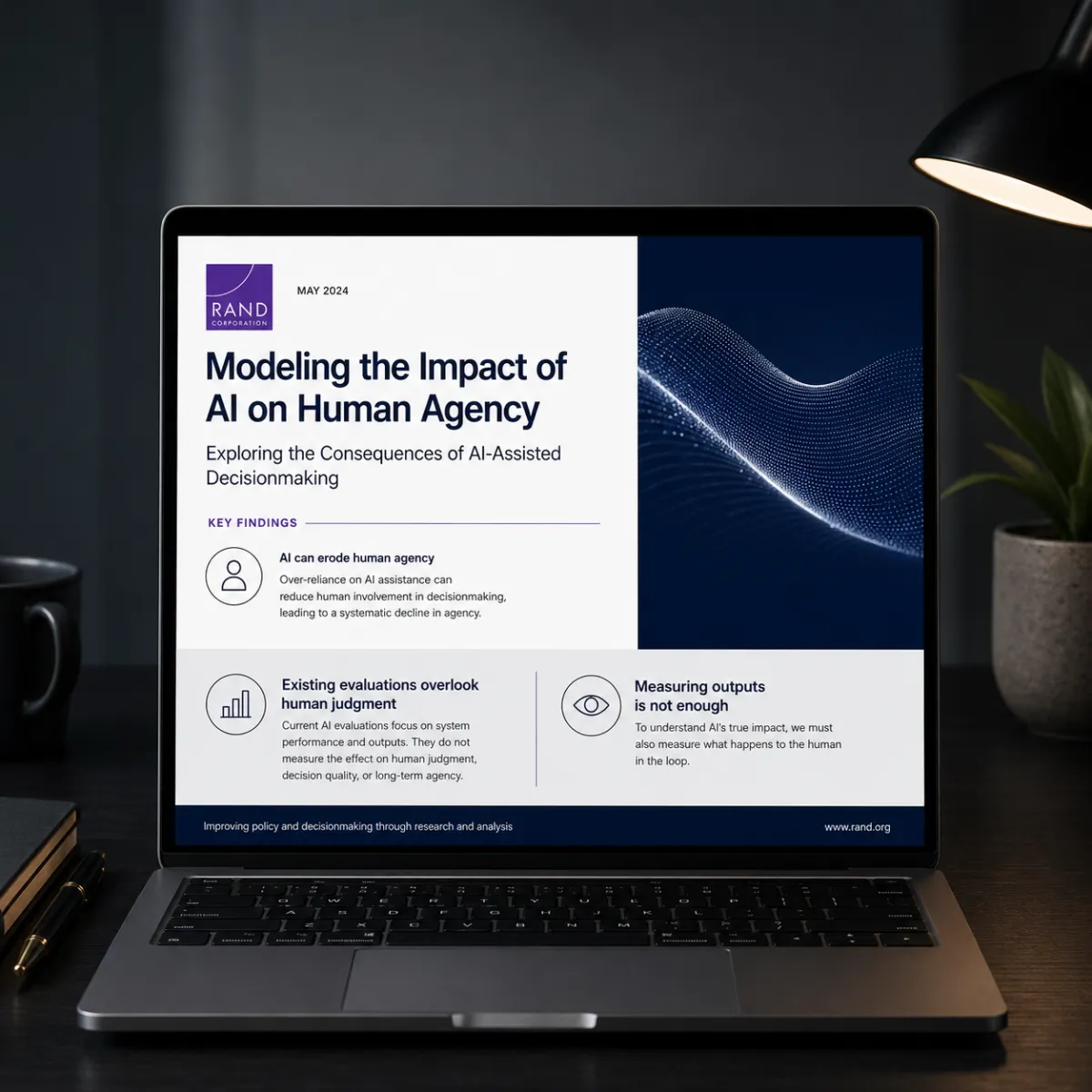
RAND published a report this year that stopped me mid-scroll.
Researchers built a formal model showing how AI erodes human agency — not through dramatic failure or obvious error, but through a slow, structural shift in who is actually making the decisions.
Here's the line that landed hardest:
Existing AI evaluations don't measure the effect on human judgment at all.
We are tracking what the AI produces. Nobody is tracking what the human is losing.
Think about that for a moment. Every benchmark, every safety test, every capability review — measuring the output. Not the operator.
Not you.
What Erosion Actually Feels Like
This is the part nobody talks about, because it doesn't feel like erosion.
It feels like efficiency.
You have a decision to make. You're tired. You're stretched. You've already made forty calls today and this is the forty-first. So you paste it in, read the response, and go with it.
That felt like a good use of AI. It probably was.
But do it for six months. Then twelve.
Notice what happens when the AI isn't available. Notice how long it takes you to think through something you used to work through in minutes. Notice the slight discomfort of having to sit with ambiguity without immediately reaching for a tool to resolve it.
That discomfort is information. It's telling you something important.
Your judgment muscle has been outsourcing its reps.
This Is Not an Anti-AI Argument
Let me be clear: I am not telling you to use AI less.
I use it every day. I build AI systems with my clients. I believe it is one of the most powerful leverage tools available to an SME owner right now.
But there's a distinction worth making — one that the RAND model actually points toward:
There is a difference between AI as a lever and AI as a replacement.
A lever amplifies what you bring to it. You are still the one lifting. You are still the one deciding where the weight needs to go. The lever just makes the lift more efficient.
A replacement takes over the lift entirely. Over time, you stop needing to be strong. And more than that — you stop knowing how strong you could be.
Most people using AI right now are somewhere on the spectrum between those two things. The question is whether they're conscious of where they sit — and whether they're choosing it.
The Question That Changes Everything
I ask every client I work with one question at some point in our work together:
Who remains the author?
Not of the content. Not of the email or the proposal or the strategy doc. Of the thinking underneath it. The judgment that shaped it. The values that decided what belonged and what didn't.
Because here's what I know from working with smart, capable operators who use AI well:
The ones who thrive don't use AI to avoid thinking. They use it to think better.
They bring a point of view. They interrogate the output. They know when the response is close but not quite right — and they know why it's not quite right, which means they can direct it toward something that is.
They are always the author. AI is always the tool.
The ones who drift are doing something different. Subtly. Often without realising it. They're using AI to skip the uncomfortable parts of thinking — the ambiguity, the complexity, the moment where you have to sit with something you don't yet know.
And those parts? That's where your judgment lives.
What Authorship Actually Requires
It doesn't require you to do everything manually. It doesn't require you to avoid AI, limit your usage, or opt out of the leverage it offers.
It requires three things:
First — you stay in the decision. Especially the ones that are relational, high-stakes, or identity-shaping. Those don't get delegated to a tool. You bring the tool to them, you use it to think more clearly, and then you make the call.
Second — you interrogate the output. Not with hostility, but with curiosity. Does this actually reflect what I think? Does this sound like me? Is there something here I'd push back on if a colleague said it? If the answer is always "looks good," something's drifting.
Third — you use active language. Not "my AI suggested" or "the tool said." You. "I decided." "I chose this because." "Here's my thinking." Ownership lives in the language before it lives anywhere else.
The Countercultural Choice
There is a quiet pressure right now to move faster. To produce more. To optimise everything. AI makes that feel not just possible but expected.
Choosing to remain the author — genuinely, not performatively — is a countercultural choice.
It means being willing to think slowly sometimes. To sit with the hard question before you reach for the tool. To notice when you're using AI to avoid discomfort rather than to amplify capability.
It means treating your judgment as the asset it is — and protecting it with the same intentionality you'd protect any other asset in your business.
RAND is now measuring the structural shift in decision-making power. The metric they're building tracks when that shift becomes irreversible.
You don't need a formal model to feel when something has shifted. You just need to stay awake to it.
One Thing You Can Do Today
Pick one decision you made this week where you used AI.
Sit with it for five minutes — without the tool. Ask yourself: do I actually agree with this? Could I explain the reasoning behind it in my own words? If I had to defend it to someone I respect, could I?
If yes — good. You're the author. The AI served you well.
If the answer is unclear, that's the work. Not changing what you decided. Just closing the gap between the output and your genuine thinking.
That gap is where authorship lives.
If this is the kind of thinking you want to do more of — on how you're using AI, and who you're becoming as you do — I work with SME owners on exactly this. Book a call here.
The tool doesn't make you less human. Forgetting to remain the author does.
Resources
(https://www.rand.org/pubs/research_reports/RRA4817-1.html)


