What They Actually Came For
What They Actually Came For
My coaching lead called me yesterday. "Rockstar," she said. "Way to crush it with your clients." She wanted to know what I was doing differently.
I didn't have a clean answer on the call. I have one now.
Here is what I actually do....
Client 1 came in wanting to build a travel blog. Get paid to write about places she'd been.
Now it turns out she’s a qualified life coach and is building a business around coaching people to design their dream trip through the lens of creating incredible experiences connected to people and places
Client 2 came in wanting a fitness app.
Now she created a program that helps women stay strong so they keep their independence as they get older
Client 3 came in wanting to scale.
She's now building the systems and the operating structure underneath a $2m business — the onboarding, the support, the way a growing team gets brought up to standard without her holding every piece herself.
None of them got what they asked for.
All of them got what they actually came for.
Here is actually what happens in session
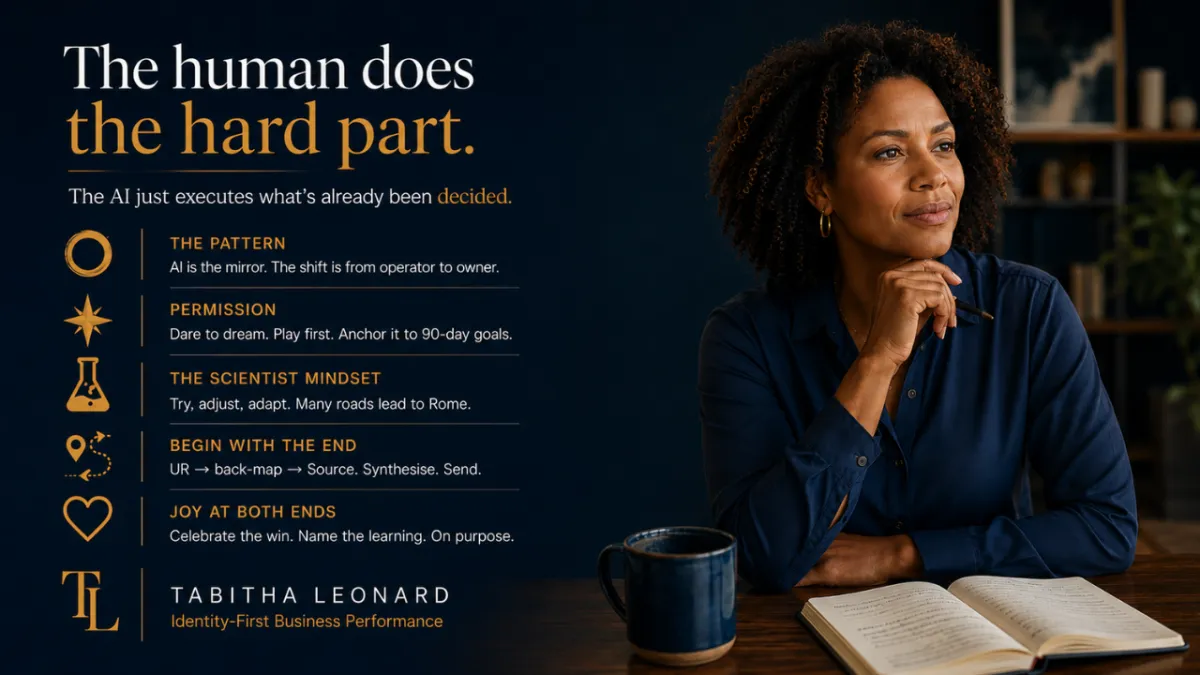
Permission Comes Before Progress
Before any framework lands, something else has to happen first. The client has to believe they're allowed to want something bigger than the constraint they walked in with.
Curiosity didn't kill the cat. It set it free.
So before I build anything, I give absolute permission to play.
Dreaming Without Limits Is Not the Warm-Up
This is where it starts, and it's not a preamble to the real work. It is the real work.
I spend real time in the desires and dreams that sit beyond someone's present limitations — not the polished goal they arrived with, but the thing underneath it they haven't let themselves say out loud yet.
Dare to dream. Then we make it come true.
That's where the child-like joy lives. Not in the delivery. In the wanting, fully, before a single constraint gets to weigh in.
You Take the What and the Why. AI Takes the How.
Here's the line I come back to more than any other: don't worry about the how. You take care of the what and the why. That's my job.
The moment I say that, something shifts. AI stops being a productivity tool and becomes a mirror. The power of it isn't speed. It's having yourself reflected back at you — clearly enough to recognise what you actually meant.
Shoot for the stars. At the very least, you'll hit the moon. The permission to dream big gets tethered to something that survives contact with reality: you don't need the full outcome to know real progress happened.
Approach It Like a Scientist Running an Experiment
Once someone knows what they want, the build runs on a different law.
Big. Exciting. Testable. Not "will this work" — "let's find out, and adjust." A failed experiment isn't a failed person. It's data. That reframe has to land before the first roadblock shows up, or the roadblock gets mistaken for a verdict.
I think in sequence. I'm a map-maker, not a fortune-teller.
Begin with the end in mind. Back-map the destination down to its simplest components, then build forward toward it — always in view of the end point, never lost in the step in front of us. This is where RPM does its work: results, purpose, map. Not a to-do list. A result worth having, a reason that's actually theirs, and a sequence built forward from there.
Source, Synthesise, Send — Lived, Not Just Taught
This is where the dream-mapping stops being a metaphor and becomes the mechanism itself.
Source is knowing what you actually think before you hand anything to the machine. Synthesise is doing something with it — not skipping straight to the output. Send is the result, shaped the way it needs to land.
The client's own dreaming is the live demonstration. They're not learning a framework in the abstract. They're watching it work, in real time, on something that matters to them.
Everyone assumes the AI does the hard part. It doesn't. The human does the hard part. The AI just executes what's already been decided.
When You Hit a Wall, Get Creative — Don't Stop
Roadblocks are not the end of the road. They're the invitation to find the alternative one.
I always have a backup in mind, because I asked AI for it before we needed it. Many roads lead to Rome. It's rarely the most direct one that gets you there. But you always try the direct one first.
This only holds if the client has already let go of getting it right the first time. Try, try, try again — completely, not as a consolation prize. Without that permission, every roadblock reads as proof of failure instead of information. With it, the roadblock is just the next data point.
Celebration Runs Underneath, Not Just at the End
All the way through the build, I'm naming how far they've come. Not saving it up for a wrap-up. Witnessing it as it happens.
This is the difference between growth that gets noticed and growth that gets totalled up once, at the finish line, and forgotten by the next session.
It Opens and Closes on the Same Note
Every session opens with the same question: what's your win from this last week?
Some clients know it's coming now. They walk in with it ready, half-proud of themselves for being prepared for the question. That's not a coincidence. That's the point.
Every session closes with a different one: what's something you appreciate, or an insight you gained?
We open in celebration. We close by naming the learning out loud. Everything in between — the dreaming, the experimenting, the roadblocks — gets to feel safe enough to actually attempt, because the container starts in joy and ends in joy, on purpose, every time.
That's not softness. That's design.
Who Remains the Author
None of this is really about AI. AI is fast, and it's useful, and it will build almost anything you point it at.
The question was never whether the machine could build it.
The question is whether the person standing behind it actually knew what they wanted before they asked.
That's what I'm coaching. Not prompting. Not apps. Not fitness programs or blogs or systems documents.
Authorship — of the dream, the decision, and the result.
Everything else is just the build.


