The tool was working. That's when it got complicated.
The tool was working. That's when it got complicated.
You built something that actually worked.
Morning check-ins. Evening reflections. A thinking partner that held the thread when the week got loud.
And then, somewhere in the middle of it doing its job, a question surfaced that no prompt had prepared you for.
Am I losing myself in this?
The misconception worth naming
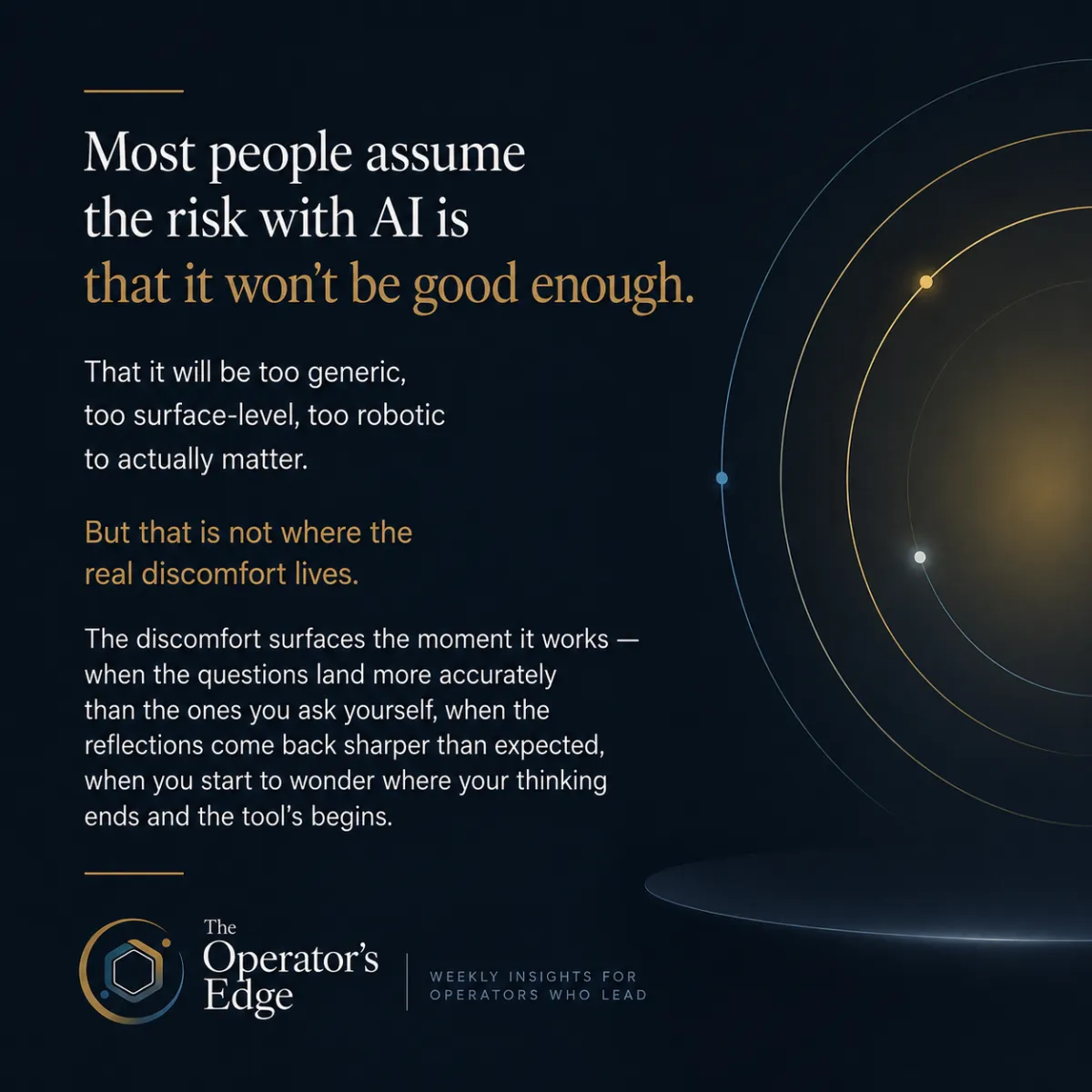
Most people assume the risk with AI is that it won't be good enough. That it will be too generic, too surface-level, too robotic to actually matter.
But that is not where the real discomfort lives.
The discomfort surfaces the moment it works — when the questions land more accurately than the ones you ask yourself, when the reflections come back sharper than expected, when you start to wonder where your thinking ends and the tool's begins.
That fear is not a problem with the AI.
It is a signal from the operator.
Three sessions into building anagent, a client came back after a week of daily use. The tool had carried them through a difficult weekend — regulation when triggered, perspective when the emotions were too loud to see through clearly.
"I'm afraid of losing myself," they said. "Of letting it make the decisions. Of not being the one who does it."
There was a pause.
Then: "Those boundaries are not about the tool. They are about you."
That was the shift.
What a refined system actually looks like
The first version of any tool is built for the problem you can see. The second version is built for the person you are becoming.
When a working system starts to feel uncomfortable, most people assume something is broken. But discomfort is often data. It is telling you that the tool has outgrown its first job — and that the operator has grown enough to notice.
Here is what the upgrade looked like in practice:
Limit suggestions to three. Enough to create a starting point. Not enough to replace the thinking that has to remain yours.
Keep the pattern-mirroring. The agent shows you what it sees. You decide what it means. That distinction matters more than it sounds.
Add a weekly celebration protocol. Not to review output. To track the moments you noticed, named, and reframed an old pattern in real time — because that is where identity shift actually lives.
The tool did not change the identity. It created conditions for the identity to surface.
And the question underneath all of it stayed the same.
Who remains the author?
Your leverage agent is not your decision-maker.
It is not your safety net. It is not the version of you that handles the hard things.
It is a mirror. A well-calibrated thinking partner that asks better questions than most meetings you will sit through this week — and hands the answers back to you.
The responsibility lives with you. It always did.
Build the tool. Refine it as you grow. Stay in the authorship.
That is what Human Intelligence in the Artificial Intelligence Age looks like in practice.


