The Day Isn’t Scattered. The Decisions Are
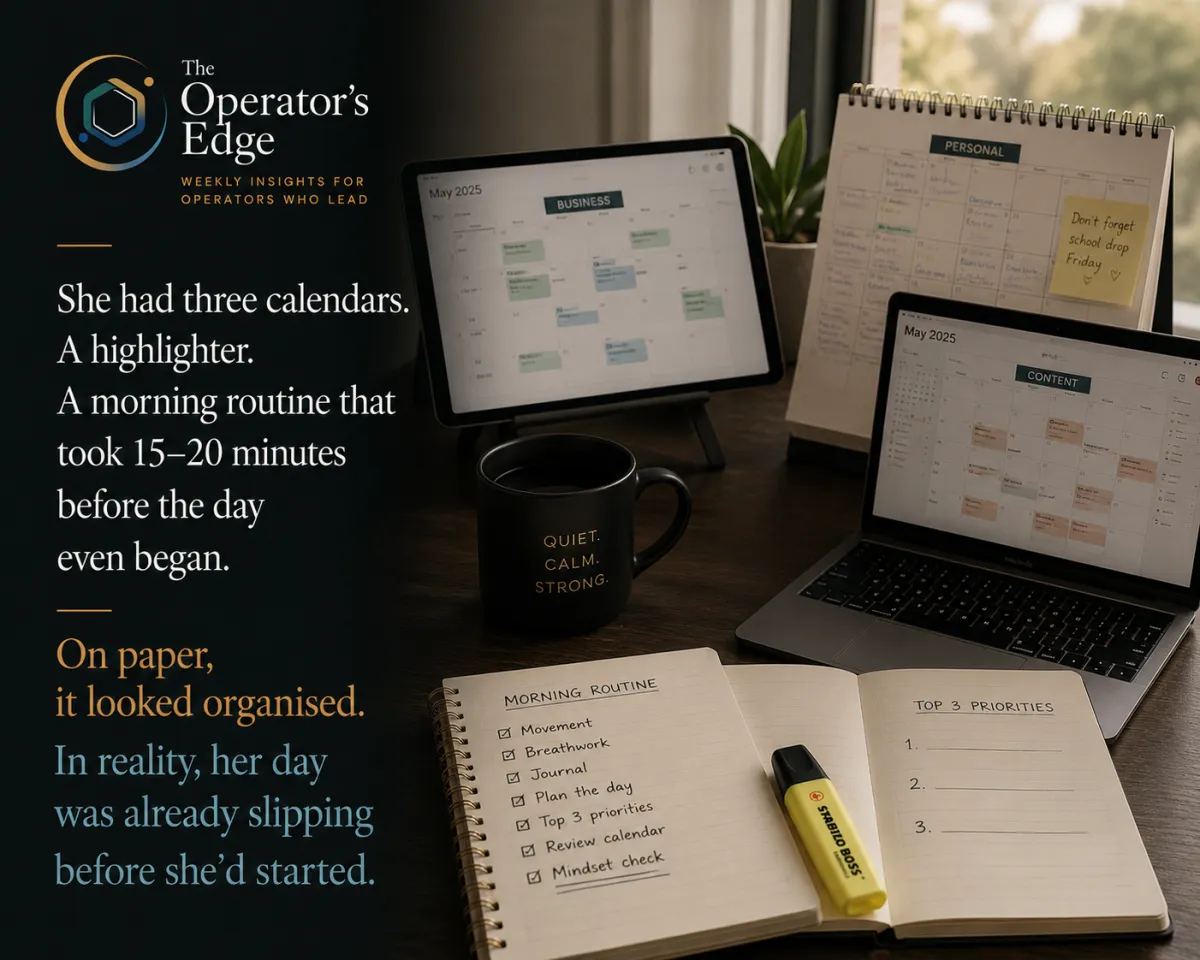
She had three calendars. A highlighter. A morning routine that took 15–20 minutes before the day even began.
On paper, it looked organised.
In reality, her day was already slipping before she’d started.
Appointments were locked in. But the work that would actually grow the business — marketing, outreach, patient acquisition — never made it in.
It lived in her head.
And that’s where the pressure builds.
The Hidden Cost of Holding It All Mentally
This is the solo operator who knows exactly what her ideal week looks like.
She can describe it clearly. She knows what matters. She knows what moves the business forward.
But without a system holding that structure, she becomes the system.
Every morning starts with decisions. What to prioritise. What to move. What to ignore.
And that repeated decision-making quietly drains:
focus
momentum
confidence in execution
the ability to protect deep work
the consistency required for growth
This is not a planning problem.
It is cognitive load.
And cognitive load is expensive.
The Misconception
Most people in this position believe:
“I just need to get more organised.”
So they add more:
Another list. Another routine. Another layer of planning.
But she already had a calendar. She already had a routine. She already knew her goals.
The issue wasn’t effort.
The issue was this:
She was still doing all the thinking.
And when the operator has to decide everything, every day, execution slows.
Not because of laziness. Because of friction.
The shift is simple. But not obvious.
You move from:
The operator who manages her day To The operator whose system runs her day
The first version relies on discipline. The second relies on design.
The first version starts from scratch each morning. The second starts with a plan already made.
The first carries the mental load. The second delegates it.
This is where momentum becomes predictable.
Not because you try harder. Because the decisions are already done.
The Practical Step
Connect your AI to your calendar and your 90-day goals.
Set it to deliver your day before you start it.
Not a list you build each morning.
A plan that lands in your inbox automatically — built around:
what is already locked in
what needs to move forward
where your focused work belongs
You open it. You execute.
From there, look at your workflow and ask:
Where are people falling through the cracks?
That is the next system you build.
One client opened a session this week by talking about what her planning agent had done.
Unprompted.
It had picked up a calendar sync issue she hadn’t even noticed. Walked her through finding the right code. Connected everything itself.
On another day, she told it she was frustrated with how long the routine was taking.
She didn’t ask it to fix anything.
She just said how she felt.
It recalibrated.
Came back with a version she could complete in three minutes.
“I was surprised,” she said. “I just talked to it like it was a person.”
By the final session, working less than two days a week in her private practice, she was already generating $10,000 a month.
And calmly mapping what scale would look like next.
You are not disorganised.
You are over-responsible for decisions your system should be making.
And when you remove that load, something shifts.
The day stops feeling scattered. Execution becomes cleaner. Momentum builds without force.
Not because you became more disciplined.
Because you stopped thinking alone.
If you want to build a system that removes decision fatigue and runs your day with you — not against you — book a call.
Let’s design the structure that gives you your time, focus, and momentum back.


